This coming weekend I will be making a presentation on my grandfather's World War I military service in the British Army. It is going to be at a meeting of the East Coast Chapter of the Western Front Association at historic Fort Mifflin near Philadelphia Airport. For information on Fort Mifflin, hit the title above. The presentation is entitled "A British 'Grunt' in the Great War: The Service of Private George T. Matchett." Complete details on the day's program below.
My maternal grandfather, George T. Matchett, was born April 15, 1892, to a father of the same name, George Thompson Matchett, a dock labourer, and mother Margaret K. Rowlands Matchett of 177 Beaufort Street, Toxteth Park, Liverpool, Lancashire, England. My Grandad told the story that he was so weak and puny when he was born that the doctor hesitated to make out a birth certificate immediately. Therefore, his birth was not recorded for a whole month; his birth certificate reads that he was born May 15, 1892. My grandfather would live to age 94, eventually dying January 18, 1987.
In 1914, he volunteered for the Lancashire Hussars Yeomanry Regiment: given his liking of horses, it made sense for him to join a cavalry unit. At the beginning of the war in 1914, my grandfather was in the Lancashire Hussars Yeomanry regiment and he spent time in camp in the first year of the war at Rufford Park near Ormskirk and Kirkby Lonsdale, Lancashire. I have a dogtag marked somewhat erroneously "T. G. Matchett 782 Lancs. Hrs. Y."
A year into the war, my grandfather was issued with a bicycle instead of a horse. The substitution was due to the fact that the slaughter of horses was so immense that all the agricultural horses had been rounded up, enforcing the total mechanization of British farming. Even this was not sufficient, so when no more than a tiny residue of horses remained, which were necessary to draw heavy munitions, bicycles were issued for the cavalrymen’s use.
Horseman, Passed By
Before the war, my English grandfather went
to Canada and became a cowboy on the prairie;
as war loomed, he returned home, enlisted
in the Yeomanry, ready to cry out "Hussar!"
as he waved his sabre, riding over the Huns
in their Pickelhaubes. I see him fresh and
bright-eyed with the cavalryman's leather
halter, neat pockets packed with brass bullets.
But it was, after all, the new, twentieth century,
horsepower on the way out. The high command
reconsidered, horses being shredded just as men,
and they issued the cavalry boys bicycles instead.
Later, Grandad ferried supplies to the Macedonian
front. I never got clear: did he ride a bike then?
Christopher T. George
For the rest of the war, he served in the Lancashire Fusiliers infantry, as a private. His Great War medals show on the rim that he was service no. 209450. G. T. Matchett was in the Lancashire Fusiliers 12th batallion as part of the British Expeditionary Force sent to Greece and based in Salonika (present-day Thessalonika). He told me he was involved in troop transports and supply into Macedonia while fighting the Bulgarians. In a somewhat self-deprecatory and low-key statement he told me that in ferrying these supplies to the front, "Some horses were killed, a few men as well."
He contracted malaria while in Salonika, symptoms of which would recur during his life from thence forward, as is characteristic of this mosquito-borne disease. His elder brother Billy Matchett (1889-1974) was a music hall comedian who entertained the troops, while his younger brother Harry Matchett served with a rifle company during the war.
WFA East Coast Chapter Spring Seminar
at
Fort Mifflin, Philadelphia, PA
9 May 2009
9 AM – Registration, Coffee and Doughnuts
10 AM – Christopher George, A British 'Grunt' in the Great War: The Service of Private George T. Matchett
11 AM – Tim Mulligan, World War I German Naval Records at the National
Archives: Access and Research Possibilities
Noon – Lunch On Your Own
1:30 PM – Tour of Fort Mifflin and Eighteenth Century Weapons Demonstration
3:00 PM – Program Ends
Registration Fee – $25 Per Person
Mail Checks Payable To: WFA East Coast Chapter
3116 S. 17th St.
Philadelphia, PA 19145
Directions from North: South on I-95, take Exit 15 Island Avenue/Enterprise Avenue. At end of exit ramp, you will be on Enterprise Avenue. At stop sign turn left onto Fort Mifflin Road. Follow road, through short tunnel, to the first left turn. See sign on right. After left hand turn, follow signs straight into the Fort. Free Parking is on left.
Directions from South: North on I-95, take Exit 13 - Valley Forge/West 291. Bear right and follow sign for Island Avenue. At traffic light (Hilton Hotel on left corner), turn left onto Island Avenue. At stop sign turn left onto Enterprise Avenue. At stop sign, turn right onto Fort Mifflin Road. Follow road, through short tunnel, to the first left turn. See sign on right. After left hand turn, follow signs straight into the Fort. Free Parking is on left.
Information Contact: JLaMonica@DCCC.edu or (610)355-7147
Saturday, May 02, 2009
Great War Presentation by Chris George at Fort Mifflin, Philadelphia, Saturday, May 9


Saturday, May 05, 2007
All the Dear Dead
I am at that point in life in which I have known more people who have now passed on compared to people I know who are still alive. . .
I reported earlier on the death of my cousin, Kenneth Matchett, who had been manager of the Bournemouth Symphony Orchestra as well as later, the manager of a trout farm for Lord Shaftesbury near Knowlton in Dorset. Now my uncle, Douglas Matchett, a former civil servant, has died age 92 in Alderney Hospital, Poole. Here are a couple of poems about his passing.
To My Uncle Douglas, in a Coma
Now they call to tell me you've suffered
a massive stroke, cocooned in a coma
at ninety-two, an ocean-width from me.
In the sea off the pine-filled chine
of Canford Cliffs, I will prepare
to scatter your ashes. We sat by
the bowling green, sipped tea; a magpie
floated down from the pines, strutted
among the shiny black bowling balls.
You will never write your life story.
Christopher T. George
The "life story" was something that Doug often talked about completing in letters and phone conversations. However, he was not really a self-reflective person and such writing would have been very difficult for him. He could be a raconteur and tell a story well, but putting his ideas down would be less easy, and I think somewhat stilted. At any rate, Donna and I will visit Poole, Dorset, on 26 May and possibly I will see then whatever progress he may have made on his magnus opus. A term he used, incidentally, for a booklong autobiographical poem called Toxteth that I published in 1976.
My uncle had a lifelong problem with memory even before senility robbed his faculties in the last years. My mother tells an anecdote in which as a young man he purchased a book called Think Clearly to help him remember and that he came downstairs to tell visitors about the putchase of the book, then forgot why he came downstairs.
Grieving
Isolated in my grief, I drive downtown
to pick up Mom's prescription, decide
not to say her brother passed yesterday,
don't wish to spoil tonight's wedding
of the granddaughter of a late friend,
in which Mom will stand in for grandma.
Now, I am driving home. I'm wearing two
red baseball caps, in memory of my uncle,
famous for wearing two ties to a funeral.
The world's shot; it's all bad news today.
Yet, on a streetcorner, a poet passes
out fresh copies of The Daily Word.
Christopher T. George
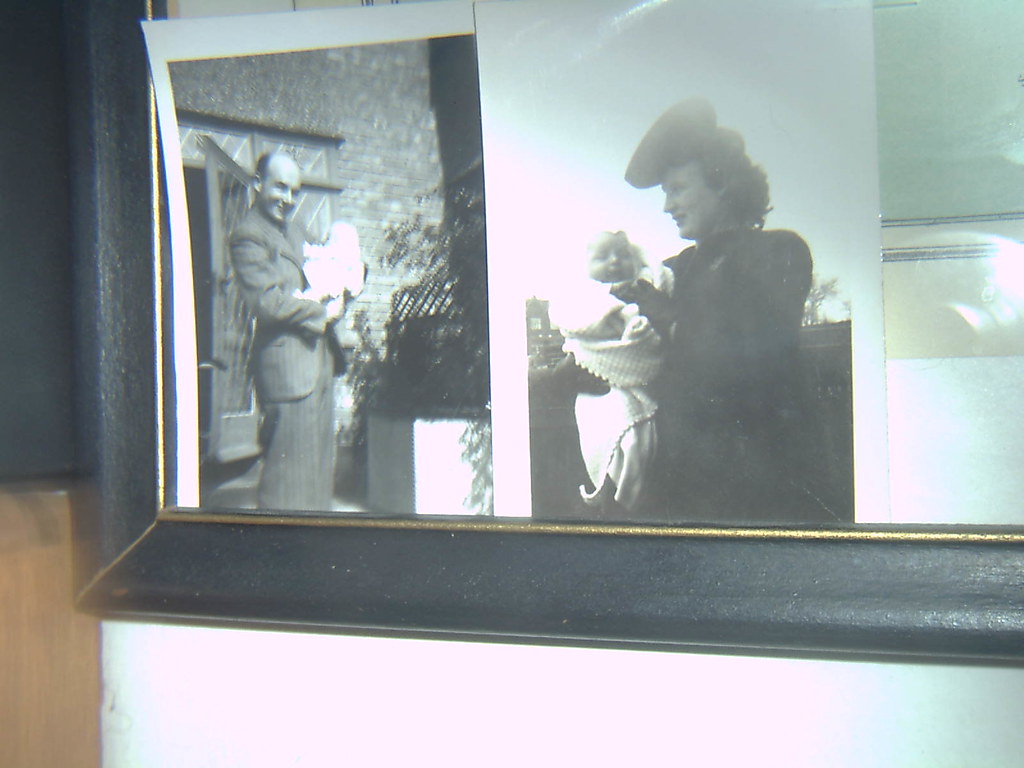
The left photograph shows my Uncle Douglas holding me in April 1948 at my christening at age three months, and the right photo my Mom on the same occasion. Get a load of that hat!